This week’s show features an interview with Wellington Heads and some sample tracks off the new album Southern Night Sky as well as music from Lowell Fulson.
Blues Roots n Boogie is broadcast each Monday evening at 8.30pm on Access Radio. 783 KHz AM or steamed live on accessradio.org.nz
Your host is Del Thomas. Del is one of the club’s hard working committee members and hails originally from Scotland.
Here’s the Podcast of our first show and features an interview with up and coming Wellington blues musician Jake Stokes as well as music from BB King, Jake Stokes, Knikki and Mike Beale plus news from the Wellington blues scene.
Blues Roots n Boogie is broadcast each Monday evening at 8.30pm on Access Radio. 783 KHz AM or steamed live on accessradio.org.nz
Your host is Del Thomas. Del is one of the club’s hard working committee members and hails originally from Scotland.
Lester Mundell was a member of the Wellington Blues Club and a harp player in his wife and musical partner Carol Bean’s band, Blue Highways. They played for Roomfulla Blues at the Bristol over a ten year period.
Lester’s day job was as a chief advisor to the Ministry of Health, he advised in the areas of disability legislation. He had four children; his son Finn and three step-daughters, Jyoti, Matreya and Mitra.
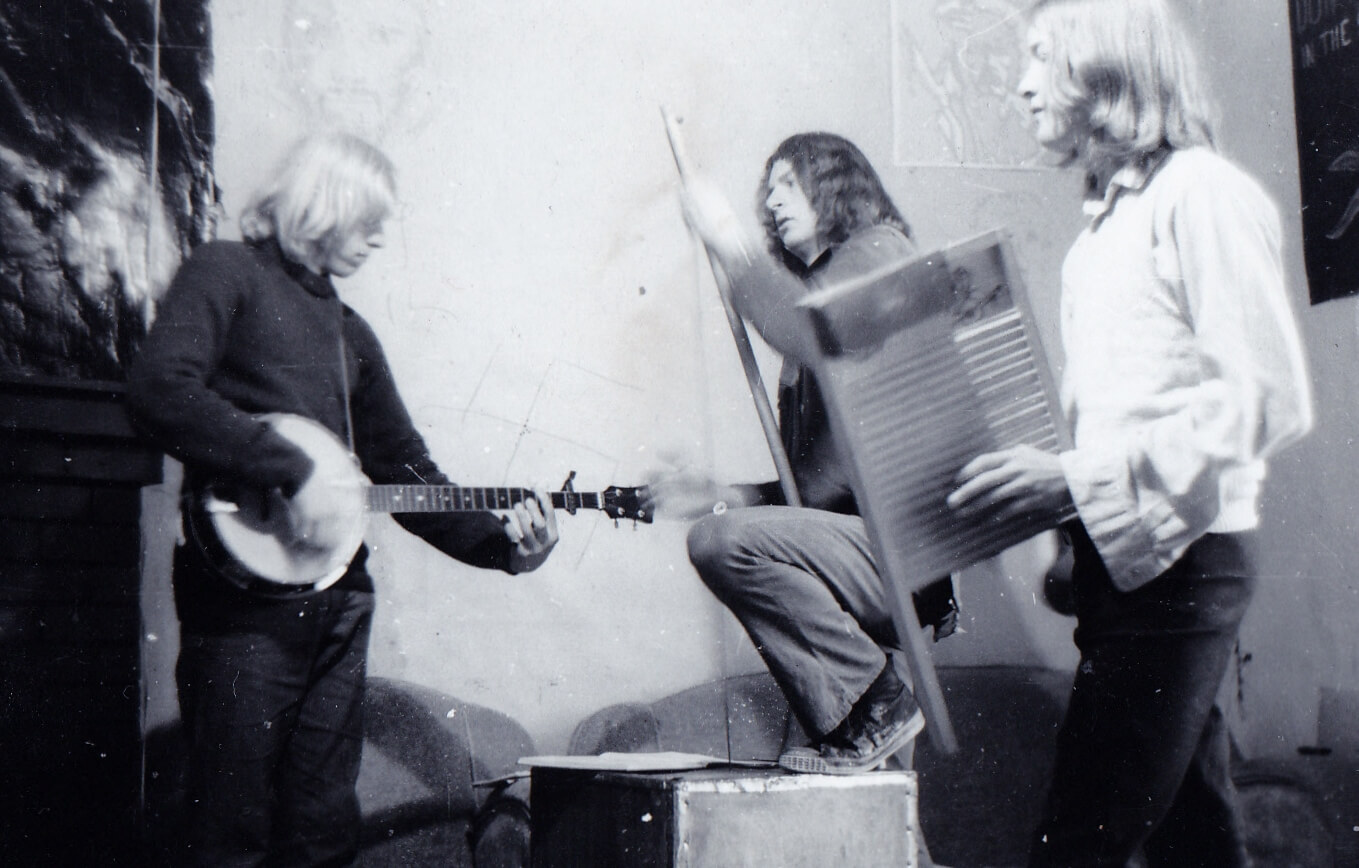
It wasn’t until Lester’s memorial service on June 6th that we discovered he’d learned to play harmonica from his musically gifted mother Dorothy. She was a pianist and a fine singer, a soprano trained by Sister Mary Leo. On the family summer holidays Dorothy would bring out her harmonica and entertain holiday makers on beaches near New Plymouth where the family grew up. She also taught Lester how to cook – another one of his passions. At high school Lester was in a Madrigal Choir and he enjoyed acting in school musicals. Lester’s first band was in Palmerston North in the late 60s. He played T-chest bass. The band was called The Anonymous Nipple and Stomach Trouble of 1968 Band. Their 2nd jug band was called The Nash Street Nooskie Band. They had a gig in Wellington once. They had one or two gigs in Palmy, but basically they just hung out and got into heaps of trouble and had fun listening and playing along to old blues and jug band albums.
At Lester’s memorial service, Rowan Peters (the guy playing banjo) arrived unexpectedly from Wales. He told the stories of those days, those infamous days of their enduring friendships and all the mad Goon Show, Furry Freak Brothers’ goings on. We laughed and we cried for Lester – a man who was gentle and loving and had great spirit and love of music. He will be sadly missed.
Lester died two years after a liver transplant. He’d had HepC since living at Nash Street, and he died of a sudden pneumonia on June 1st, 2015. May he Rest in Peace.
All roads lead to the Pope for Wellington blues singer Laura Collins.
The 45-year-old will open and close the second annual Voices of Faith event at the Vatican next month with a hauntingly beautiful ballad penned by fellow Kiwi musician Steve Cournane and accompanied on piano by Wayne Mason, writer of the 1960s pop hit Nature.
“The whole thing is pretty surreal. I’m kind of humbled really. It is hard to believe,” Collins said yesterday.
The opportunity is the result of her friendship with Cournane, a former Wellingtonian whose Peruvian wife, Rocio Figueroa, is second-in-charge of the annual event. It was founded last year after Pope Francis called for a greater female presence in the Catholic Church.
Cournane was asked to compose a song for this year’s event and hand-picked Collins to record the song Voices of Faith. “I knew immediately I wanted to do it with people from New Zealand,” he says.
Mason Kapiti-based keyboard maestro Wayne Mason, who wrote the 1960s hit Nature, played piano to Collins’ vocals at recently closed Braeburn Recording Studio in Wellington. “What they sent back to me blew me away,” Cournane says of their recording, which was swiftly sent to the event directors.
“The next thing was, ‘Will you come to Rome to sing it?’,” Collins said. “It’s one of those left-field things life throws up. It’s an honour, and what a great opportunity.”
Mason will miss out on the Vatican trip because of cost. An Italian pianist will accompany Collins.
has been reading up on Italy and papal protocols. “What to wear – that is a major question for me. Basically we’re going with elegant.”
iwi heritage will be on display with a special piece of pounamu around her neck, created for her by a Hokitika-based musician friend.
While not Catholic herself, Collins says she is “spiritual” and supports Pope Francis’ push to empower women, a theme she includes in her own songs.
“I’m a feminist of old and this (event) rings true to me.”
She admits it will be “pretty wild” if she gets to meet the Pope.
The foundation’s executive director will formally invite the Pope this week to five-hour event is on International Women’s Day, March 8, in a room near the Pope’s living quarters. He has been invited and organisers are hopeful he will attend.
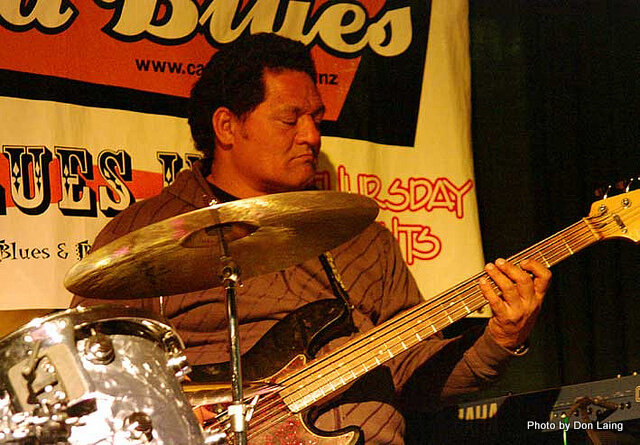
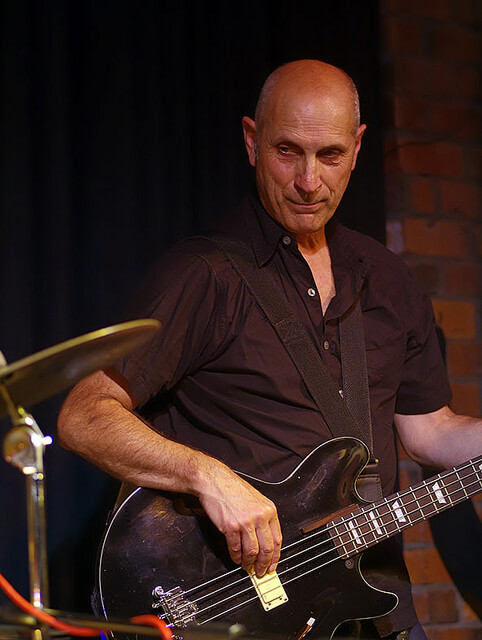
You’ll often see Elliot Fuimaono on bass at the Bristol, leaning back with eyes slightly closed, behind Darren Watson, Dave Murphy, or the Kemptones. His baselines have anchored many a jam night and special show, and he has recorded with Darren Watson, Brannigan Kaa, and Carol Bean. Recently I joined Elliot for a quiet beer and a chat.
In 1960 Elliot Fuimaono was born to Maori and Samoan parents in the King Country town of Taumarunui. His early life centred around family and church: first a mainly Maori church, then a Samoan church after his family moved to Wellington when he was 9.
Music started with singing at church, and later playing on family instruments. He took up bass at his brother’s 21st. His brother was the usual bass player for the family band, but he didn’t want to do it on his birthday so Elliot filled in and has never stopped. He has been playing in family bands since 1975. They used to play open air Christian gigs at Pigeon Park on Sundays, then switched to playing covers, and later originals, as Taste of Bounty.
After the death of dynamic Hendrix-inspired lead guitarist Roy Fuimaono, the band became Bounty, then New Shuz, playing mainly pubs, but also at Sweetwaters. Elliotte joined Brannigan Kaa’s Brown Street about the same time as Chicago Smokeshop was smoking stages all over New Zealand. The bands went to each other’s gigs, often playing at the Oaks and at Western Park jams.
The 90s found him joining South Side of Bombay, who had been going 6 years and already had a hit single ‘What’s The Time Mr Wolf’. Elliot spent 3 years with them, touring New Zealand, Australia and Noumea as a full-time musician. That was quite a cool band, wasn’t it? “Apparently – I was only in it!” Lance Sua told me once that touring with SSOB was what made you as a bass player. “Apparently … [Laughs] Well, I suppose you make less mistakes.”
At jam nights you pick up songs very quickly by ear. You seem to have very good ears. “Apparently!” How did you end up getting involved with the Blues Club? “I started coming along about 4 or 5 years ago just to listen and enjoy the night. I already knew Dougal Spier – he was nice to me. I didn’t know anyone else. Then I started playing music with Dougal. I love the Blues Club. I like to go along no matter who is playing.”
Who do you admire? “I like all the big names but I like watching local guys play. I get more out of that than US players. It’s not like watching a DVD. It’s more immediate.”
New Zealand bass players he likes include Brent Thompson, Max Stowers, Max Hohepa, Ryan Monga, Paul Dyne, and another familiar face at the Blues Club, George Barris.
Elliot admits that punctuality isn’t his strong point. A couple of times he’s turned up for a gig after the band has started playing. “Everyone knows I’m going to be late, but I’m going to turn up anyway.” I mentioned that at the previous evening’s jam I was tired and ratty, didn’t feel like singing at all, but once I started playing I suddenly found my mojo. “It always happens like that. Sometimes you turn up, you’re so tired … you’ve been on the jackhammer all day [at work], but you start playing and you get a big lift that carries you through. It happens straight away, as soon as you start the first song.”
Bluznuz guest editor (June issue) – Al Witham – June 2008
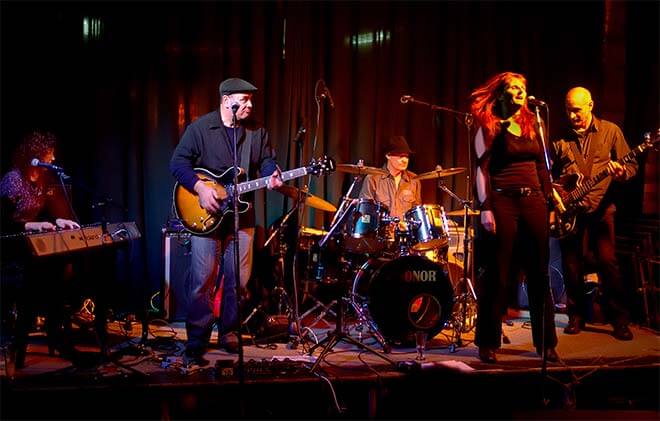
Don Laing has alerted us to a new entry in the new Creative and Intellectual Life section of Te Ara – the Encyclopaedia of NZ, featuring Bullfrog Rata and Laura Collins playing at our very own Roomfulla Blues, “organised by Capital Blues Inc, the Wellington blues club“. Credit for the wonderful action photo to Don Laing.
George is a stand-up man who plays a stand-up bass and electric bass.
This month, George Barris is onstage with both Highway and Midnight Ramblers.
“My first professional band was The Bitter End from Wellington. In 1968, I moved to Auckland and joined The Underdogs.” ”
In late 1968 I formed Jigsaw with Underdogs drummer Tony Walton and two friends from Wellington, Chaz Burke-Kennedy on guitar and Glyn Mason on vocals. When Glyn left to join The Rebels we became Fresh Air with Chris Seresin on keyboards.”
“I briefly joined Troubled Mind, then moved back to Wellington and was approached to join Highway.” “I did a stint with Blerta after Highway in the early 70s, and between that and my present tenure with Laura Collins, there have been too many bands and gigs to mention!”
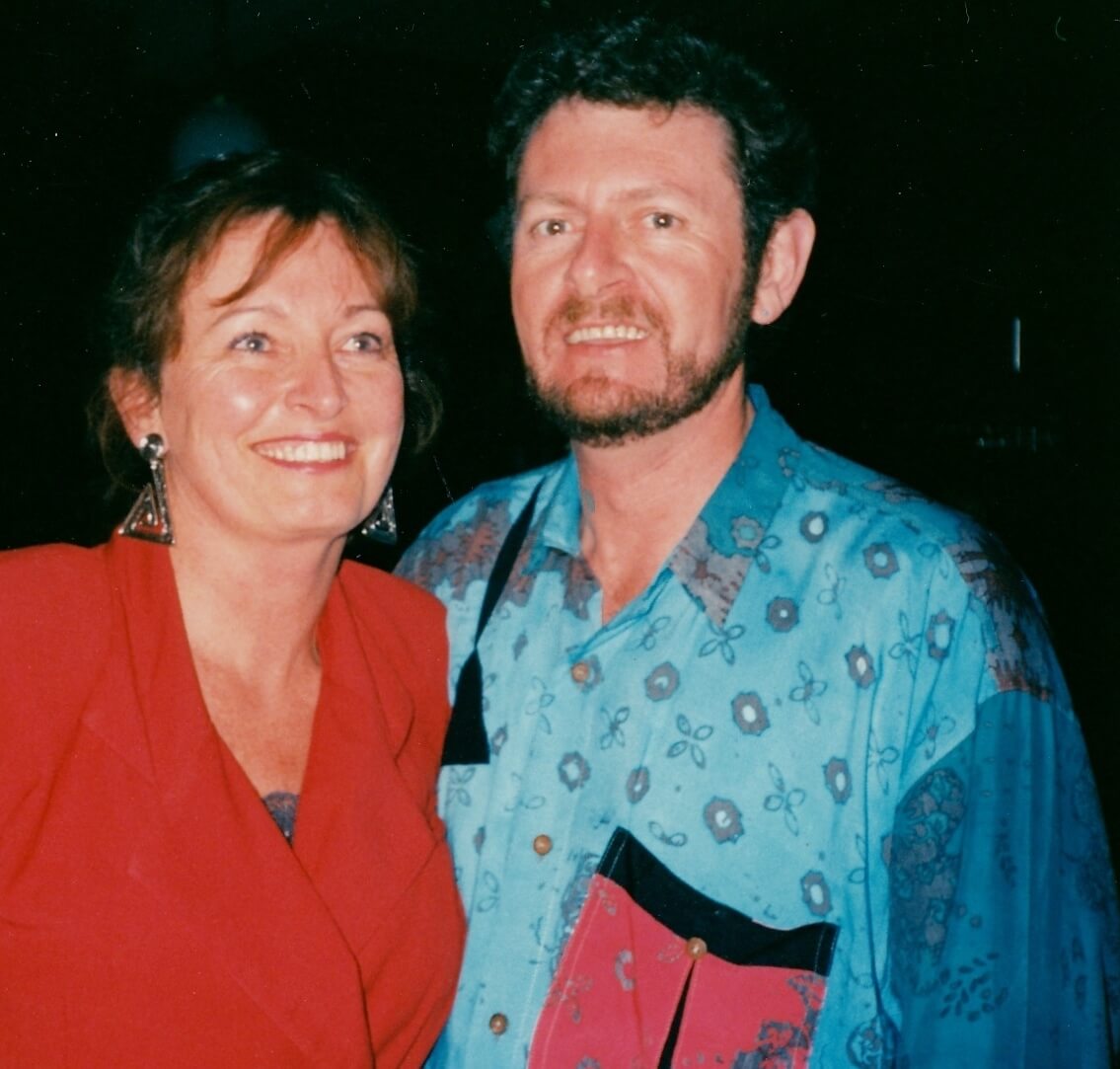
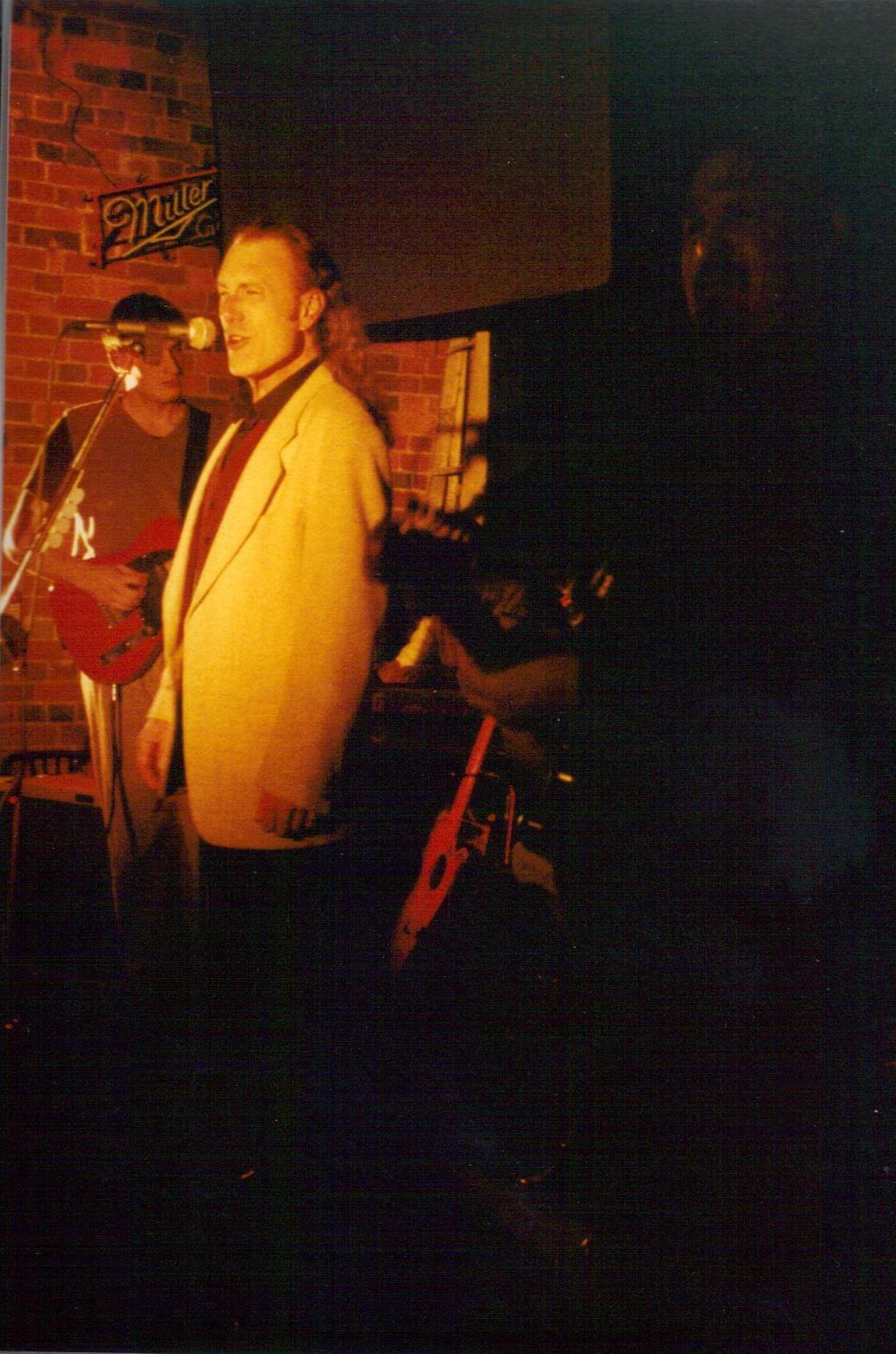
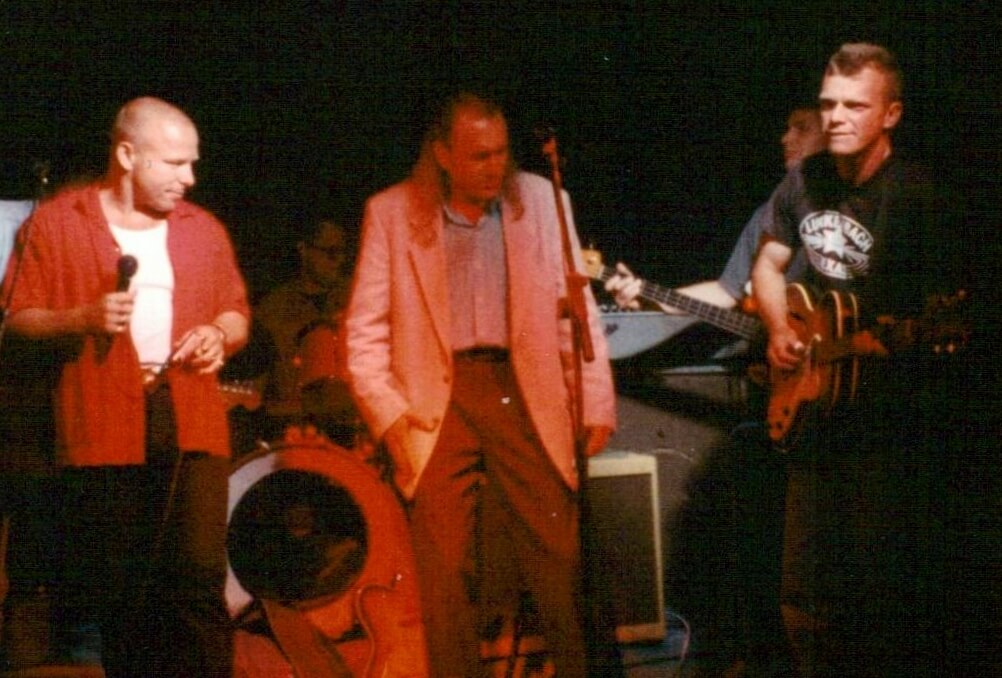
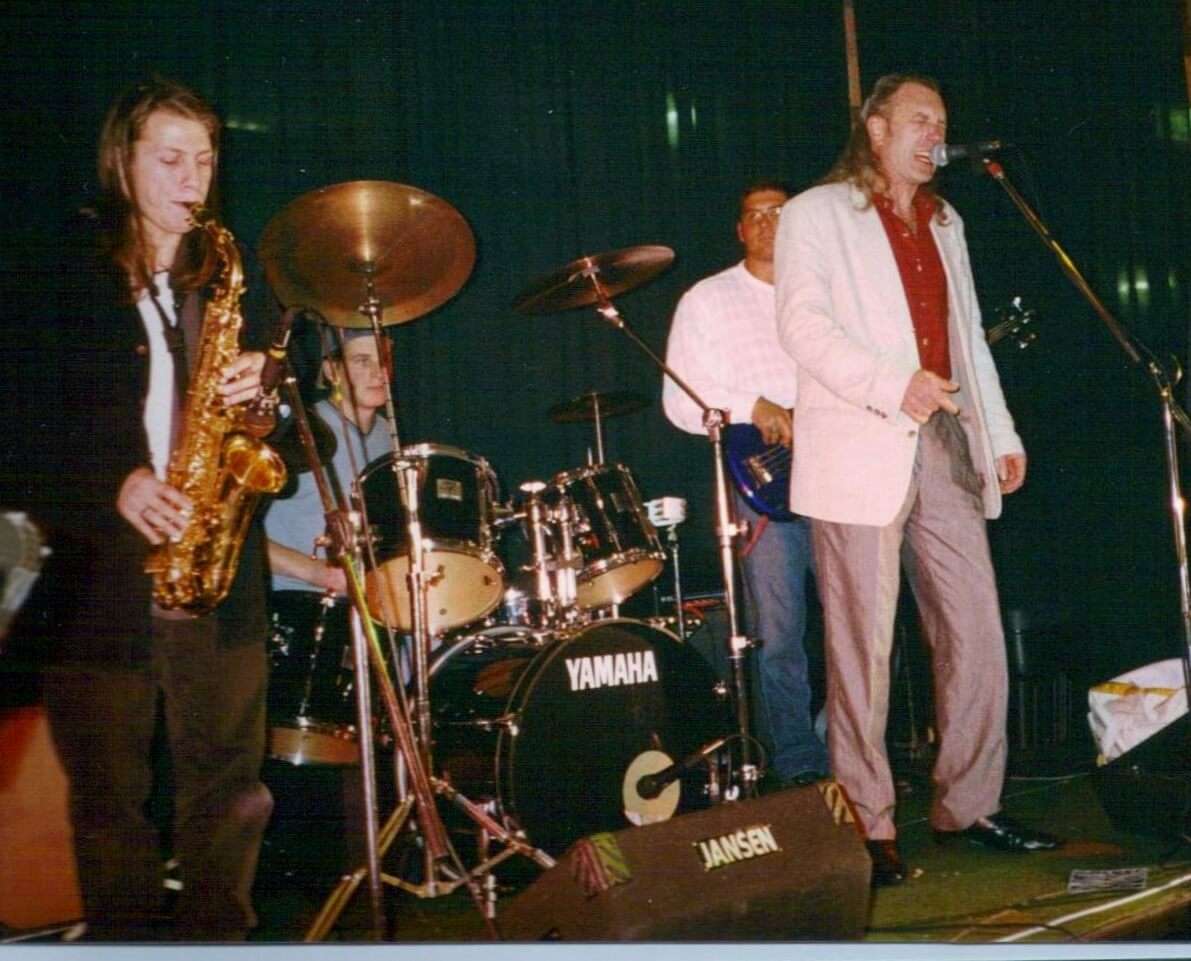
Mike Jones was a class act. He sang at the Roomfulla Blues many times. For those who remember, here are some photos from Trudy Benham’s collection. We say, a fond farewell to a great musician!
Robin Howard Winch, musician. B 14 August 1952, Nottingham, England; m Ann (dec), 2 s; d Wellington, 8 August 2012, aged 59.
Rob Winch and his brother Martin were stalwarts of the New Zealand music scene who came to prominence as members of the fabled 1860 Band, the jazz-influenced rock outfit in Wellington that took its name from the long-defunct Lambton Quay bar they were resident at and where they commanded a large and loyal following in the late 1970s. Tragically, both brothers were to die young from cancer, Martin predeceasing his younger brother by less than 18 months. In another bitter twist, Rob had lost his beloved wife Ann to cancer last year.
The 1860 Band was something of a revelation on the local music scene. Most of the members were veterans of the mighty Quincy Conserve, a band that played for many years at the old Downtown Club. Two of this new band’s line-up were relative newcomers to Wellington, brothers Martin and Rob Winch on guitar and bass respectively. Who could have known then the lasting impact these two would have on the New Zealand music scene in the decades ahead.
Rob was a rock steady yet wonderfully creative bass player who could, at the drop of a hat, deliver phenomenal and inventive melodic solos, ideally suited to the jazz-rock repertoire of the band. He was also their main singer. Not many people were initially aware that he, like his brother Martin, was also a superb guitarist.
Originally from Nottingham, England, Rob arrived in Auckland with his family in 1963. They soon relocated to Nelson, where Rob was a pupil at Nelson College. His father had been a Policeman in the UK, and Rob was considering a career in the probation service after finishing school. Instead, he discovered that he had a talent for music and succumbed to the lure of the guitar and a life on the road as a member of numerous pop and rock bands.
In the early 70’s Rob moved to Wellington, where he became a member of the popular psychedelic folk/rock group Tamburlaine. By the mid-seventies he was playing in Christchurch with Brigade before returning to Wellington to join the outfit he was to become most closely associated with – the 1860 Band.
When original bass player Dave Pearson left, Rob was recruited and shortly afterwards he suggested that the band hire his brother, Martin, from the recently defunct Auckland band Dr Tree, as guitarist and the rest, as they say, is history. At their peak, the 1860 Band was undoubtedly the biggest crowd pulling crew in town. It was with this band that Rob’s compositional talent began to develop, and he wrote the track ‘Von Tempsky’ for the album of that name. He also shares lead vocals with Geoff Culverwell on the bands biggest selling single, ‘That’s The Kind Of Love I’ve Got For You’.
Rob was bass player for the Rodger Fox Big Band from 1978 to 1981. He accompanied them on their 1980 tour to Montreux, Switzerland, where their performance was recorded live before continuing to New York, where they cut “New York Tapes”, a most excellent album. Then in 1981, the band toured to the UK, Montreux (and another live album) and Poland.
Back home, he began to develop and expand his skills to encompass work as a vocalist on numerous recording and television sessions and added the art of percussion to his repertoire. All this led him quite naturally into the business of jingle writing, and he quickly became the ‘go to’ guy for advertising agencies needing a campaign. That launched his career as the music creator of countless recording studio, television and film production company projects around the country and abroad. Undoubtedly, his most recognisable television commercial sound track is the iconic ‘Cruising On The Inter Islander’.
In 2003, Rob once again teamed up with Martin to tour their tribute to Eric Clapton show around the country to sell out houses. Later that year, he took his family to live in Nashville for several months while he recorded an album of his own compositions, “It’s About Time”.
Stricken by several devastating illnesses in more recent years, the lad never complained and many never knew he’d been gravely ill. In 2011, having cared for his beloved wife Ann until her untimely death, he again ventured out into the live performance scene and showed that he still had more than most to offer where serious guitar chops were concerned. Such a player, such authority, such feeling. Those lucky enough to see and hear him at his last gigs at the Bristol Hotel in Wellington were enthralled at his passionate, inspired guitar solos and soulful singing – Clapton would have saluted him.
Hugely admired by musicians and fans alike for his impeccable musical taste, his creativeness, humble attitude, genuine interest in others and a truly insane sense of humour, Rob had the lovely gift of being able to positively influence the lives of almost all those he came in contact with. His circle of friends was wide and encompassed not only those from across the creative community here and abroad, but people from all walks of life.
Robin Howard Winch died peacefully in Wellington Hospital from complications following a bone marrow transplant on 8 August 2012, six days short of his sixtieth birthday. His life was celebrated to the full at his funeral, held in Wellington on 13 August 2012. He is survived by his mother Molly and his sons Ben and Riley.